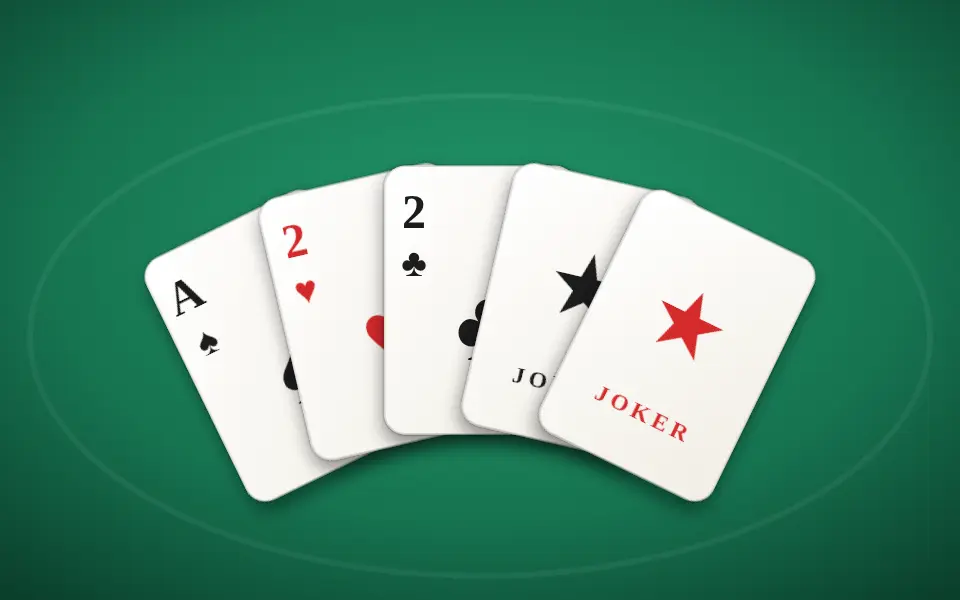
These Dou Dizhu rules will take you from zero to your first game in about ten minutes. Dou Dizhu (斗地主, literally "Fight the Landlord") is the most popular card game in China, played by hundreds of millions of people online. It is a three-player game: one player becomes the Landlord and plays alone against two Peasants who work as a team. The first side to get rid of all its cards wins. Below you will find the deck, the deal, bidding, every legal card combination, bombs, scoring and a few beginner tips.
The deck, the players and the goal
Dou Dizhu uses a standard 52-card deck plus two jokers, 54 cards in total. Suits do not matter at all; only ranks count. From lowest to highest the ranks are:
3 · 4 · 5 · 6 · 7 · 8 · 9 · 10 · J · Q · K · A · 2 · Small Joker · Big Joker
Notice that the 2 is the highest ordinary card, above the Ace, and only the two jokers beat it. Your goal is simple: be the first player to play every card in your hand. If the Landlord empties their hand first, the Landlord wins. If either Peasant empties their hand first, both Peasants win.
Dealing and bidding for Landlord
Each player is dealt 17 cards, and the last 3 cards are placed face down as the kitty (sometimes called the bottom cards). Then the bidding begins.
- Starting with a chosen player and moving in turn, each player may bid 1, 2 or 3 points, or pass.
- Every bid must be higher than the current highest bid.
- A bid of 3 ends the auction immediately. Otherwise, bidding ends after every player has had a turn.
- The highest bidder becomes the Landlord. If all three players pass, the cards are reshuffled and dealt again.
The Landlord picks up the 3 kitty cards, so they start with 20 cards against the Peasants' 17 each. The kitty is revealed to everyone, which gives the Peasants useful information. The bid also sets the base score for the hand, so bidding 3 on a strong hand is how you win big.
Every legal card combination in Dou Dizhu
On your turn you must play a legal combination. These are all the combinations you can use, from the simplest to the most powerful:
| Combination | What it is | Example |
|---|---|---|
| Single | Any one card | 7 |
| Pair | Two cards of the same rank | 9 9 |
| Triple | Three cards of the same rank | Q Q Q |
| Triple with a single | A triple plus any one card | Q Q Q 4 |
| Triple with a pair | A triple plus any pair | Q Q Q 4 4 |
| Straight | 5 or more consecutive singles, from 3 up to A (no 2s or jokers) | 8 9 10 J Q |
| Pair straight | 3 or more consecutive pairs | 5 5 6 6 7 7 |
| Airplane | 2 or more consecutive triples, optionally with one single or one pair per triple as "wings" | 6 6 6 7 7 7 3 J |
| Four with two | Four of a kind plus two singles, or plus two pairs | 8 8 8 8 3 K |
| Bomb | Four of a kind played alone | J J J J |
| Rocket | Both jokers together; the strongest play in the game | Small Joker + Big Joker |
How a round of play works
The Landlord leads first and may play any legal combination. Going around the table, each following player must either beat the last play or pass. To beat a play, you normally need the same type of combination with the same number of cards and a higher rank: a pair of Kings beats a pair of 10s, and a 6-card straight can only be beaten by a higher 6-card straight. For combinations with attached cards, only the main part counts; in Q Q Q 4 it is the Queens that matter, not the 4.
When two players pass in a row, the last player who played wins the round and may lead anything they like. Passing does not stop you from playing later in the same round if play comes back to you.
Bombs and the rocket
Bombs break the "same type" rule. A bomb beats any ordinary combination, whatever its size, and a higher bomb beats a lower bomb. The rocket beats everything, including every bomb. Because they are so powerful, bombs also change the score, which is covered next.
Scoring: bids, bombs and spring
The value of a hand starts with the winning bid (1, 2 or 3) and is doubled by special events:
- Every bomb or rocket played during the hand doubles the score. Two bombs means ×4.
- Spring: if the Landlord wins and neither Peasant played a single card, the score doubles again.
- Anti-spring: if the Peasants win and the Landlord only ever played their opening lead, the score doubles too.
The Landlord wins or loses that amount from each Peasant, so the Landlord's swing is twice as large as either Peasant's. That is the reward, and the risk, of bidding high. Scoring conventions differ slightly between apps and families, but this doubling structure is the classic version, and it is the one used on AI Game Arena.
Beginner strategy tips for Dou Dizhu
- Plan your hand before you play. Group cards into straights, airplanes and pairs so you are left with as few awkward singles as possible.
- Count the big cards. Track the jokers, 2s and Aces. Knowing whether the Big Joker is still out tells you whether your 2 is safe.
- Save bombs for the right moment. A bomb that takes the lead when an opponent has two cards left is worth far more than one thrown away early.
- As a Peasant, help your partner. If your teammate is close to finishing, play low cards that let them take the lead, and use your high cards to stop the Landlord.
- Only bid 3 with a real hand. Rockets, bombs and several 2s make a good Landlord hand. Many long straights with no high cards do not.
Play Dou Dizhu against AI online
The fastest way to learn is to play. On AI Game Arena's Dou Dizhu table you can sit down with two AI opponents such as GPT, Claude, Gemini or DeepSeek, or let three models play each other and watch how they bid, team up and use their bombs. Every AI gets exactly the same view of the game, which makes it a fun way to see which models actually understand hidden-information card play. Curious how the chess side compares? Read Can LLMs play chess? or meet the full lineup of AI players.